
Music
June 29, 2022 · canan · 7 views
Kazım Koyuncu
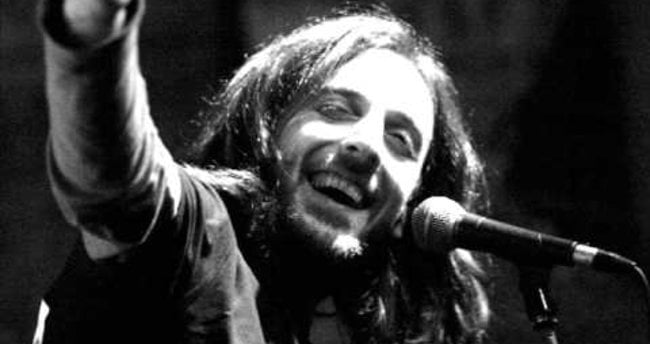
June is the first love of the summer season. The beginning of the sun's warm embrace of the universe. In June, one's mind fills with the sounds of children, birds, cats, and dogs; deep blue bays, lush green streets, and trees heavy with fruit. Even for no particular reason, our souls can overflow with an involuntary joy. Within these sounds and images, pain keeps its distance from mankind, and death feels entirely non-existent. Yet, alongside the history of the world, the history of humanity is saturated with sorrow. And people "resemble the places they live"; death can arrive and seize you at the most unexpected moment. Just like Kazım Koyuncu, whose life merged its footsteps with art.
Kazım Koyuncu was born on 7 November 1972 in Hopa, Artvin. He was a son of the Black Sea, a Laz. He sang songs in Lazurî. In doing so, he introduced his native tongue, which was on the brink of vanishing, to the entire country. (Today, no fewer than eighteen languages are endangered in Turkey alone, and Lazurî is one of them). Even those who didn't speak a word of the language sang his songs. This demonstrated the unifying power of songs and the human voice, proving that bringing people together is the most potent act of all.
In 1993, he formed the folk-rock band Zuğaşi Berepe (Children of the Sea). After the band split, he released two solo albums: Viya and Hayde. Although his songs grew deeply loved over time, like all artists who create through genuine labour and steer clear of commercial populism, he carried quiet grievances along his path: "I've been making music for all these years and could never make myself accepted; then I did a few pieces for a television series, and suddenly everyone started loving me." For the task is always hard for those whose sole concern is art, those who use art to articulate the sorrows of the people.
Is this not the reality of life? It is incredibly difficult for an artist to achieve recognition without debasing themselves in populism, or to perform their music precisely as they wish. Besides, we live in societies that only truly appreciate souls once they are gone, and he was undoubtedly aware of this. This is why, when looking at the vast crowds in his concert footage, he would marvel at it, expressing his sheer disbelief. After all, he had given years of dedicated labour, yet it was only through a television series that he finally managed to make his voice heard.
They called him "the wildest child of the Black Sea". He was a revolutionary. He left his mark upon the waters of history by saying, "I am a musician, then I am a bit of a Black Sea soul, but above all else, I am a revolutionary." He walked a different path. In his own words, he behaved differently toward the local grocer or the greengrocer. For he possessed a heart as unyielding as steel, dreaming always of the revolution.
He looked at life through a universal lens. "All the lands of the entire world belong to all of us. All songs belong to all the people of the earth. And the whole earth is our homeland," he said. This was how he greeted the peoples and nations of the world. He never viewed any race as superior to another; the ideals of equality, liberty, justice, and fraternity stood above everything else. At the intersection where life meets art, he carried his own burden, believing with an infinite faith that another world—the one he envisioned—was entirely possible.
And then, Chernobyl. The explosion at the fourth reactor of the Chernobyl Nuclear Power Plant, near the city of Pripyat in northern Ukraine, released radiation into the environment equivalent to fifty times that of the atomic bomb dropped on Hiroshima in 1945. Clouds heavy with radioactive material affected numerous nations, including Turkey. According to certain studies, this catastrophe caused the direct or indirect death of roughly two hundred thousand people. The authorities, however, never acknowledged the truth.
Kazım Koyuncu was only thirty-three when he passed away from cancer. Although the vast majority of officials refused to link the soaring cancer cases in the Eastern Black Sea region to Chernobyl and state negligence, he refused to accept their lies. He criticised the authorities. He filed lawsuits. When the judge in the courtroom asked him, "Is there a history of cancer in your family?" he replied simply, "Yes, me." He fought against every injustice until his very last breath. His stance against life, his stride, and his way of singing never wavered. Albert Camus's words, "If the world were clear, art would not exist," mirrored the luminous world he envisioned and sang of in his songs. For art is born out of human sensitivity; that which is crafted out of pure selfishness can never be art.
Nature, much like true artists, never dies. It renews itself in every era, continuing to live and sustain life. Because it is not an imitation; it is real. There is substance to its words, a harmonious union of the heart and human wisdom. It draws from nature, refines it into sensitivity, and presents it to humankind. What art articulates are the unvarnished realities of the people. It is not sycophancy. It is not a performance. As Balzac noted: "The mission of art is not to copy nature, but to express it." He embraced the core of the land he was born upon and carried it to a universal dimension, giving voice to everything pertaining to humanity through his songs, guarding his nature in this way.
Asserting that to forget is to kill, and to remember is to keep alive, we remember him once again today through his songs, his words, and his struggle. By saying, "I am somewhere in the world," he became the living embodiment of the truth that "it is only the flesh that dies". Kazım Koyuncu passed through this world; and through his voice, his footsteps, and the works he left behind, he achieved immortality in the cosmos.
Comments
No comments yet. Be the first to comment.